from bokeh.plotting import figure, show, output_file
from bokeh.models import Label, HoverTool, ColumnDataSource, CustomJS, TapTool, GlobalInlineStyleSheet
from bokeh.layouts import row
import numpy as np

def get_dark_stylesheet():
    """Create a new dark theme stylesheet instance."""
    return GlobalInlineStyleSheet(css="""
        html, body, .bk, .bk-root {
            background-color: #2b2b2b;
            margin: 0;
            padding: 0;
            height: 100%;
            color: white;
            font-family: 'Consolas', 'Courier New', monospace;
        }
        .bk { color: white; }
    """)

def get_light_stylesheet():
    """Create a new light theme stylesheet instance."""
    return GlobalInlineStyleSheet(css="""
        html, body, .bk, .bk-root {
            background-color: #f5f5f5;
            margin: 0;
            padding: 0;
            height: 100%;
            color: black;
            font-family: 'Consolas', 'Courier New', monospace;
        }
        .bk { color: black; }
    """)

def plot_arc_diagram(nodes, edges, node_colors=None, edge_weights=None,
                     title='Arc Diagram', width=1200, height=800,
                     node_size=15, arc_height_scale=1.5,
                     dark_bg=True, show_labels=True):
    """
    Create an enhanced arc diagram with click-to-filter interactivity.

    Parameters:
    -----------
    nodes : list
        List of node names/labels
    edges : list of tuples
        List of (source, target) pairs where source and target are node indices
    node_colors : list, optional
        Colors for each node
    edge_weights : list, optional
        Weights for each edge (affects arc thickness)
    title : str
        Chart title
    width, height : int
        Figure dimensions
    node_size : int
        Size of node circles
    arc_height_scale : float
        Scale factor for arc heights
    dark_bg : bool
        Use dark background theme
    show_labels : bool
        Show node labels

    Returns:
    --------
    bokeh figure object
    """
    bg_color = '#2b2b2b' if dark_bg else '#f5f5f5'
    text_color = 'white' if dark_bg else 'black'

    n_nodes = len(nodes)

    # Default colors
    if node_colors is None:
        node_colors = ['#3498db'] * n_nodes

    # Normalize edge weights
    if edge_weights is None:
        edge_weights = [1.0] * len(edges)
    else:
        max_weight = max(edge_weights)
        edge_weights = [w / max_weight for w in edge_weights]

    # Create figure
    p = figure(
        width=width,
        height=height,
        title=title,
        toolbar_location='right',
        tools='pan,wheel_zoom,reset,save',
        background_fill_color=bg_color,
        border_fill_color=bg_color,
        x_range=(-0.5, n_nodes - 0.5),
        y_range=(-0.2, 1.1)
    )

    # Styling
    p.title.text_color = text_color
    p.title.text_font_size = '18pt'
    p.title.text_font_style = 'bold'
    p.xaxis.visible = False
    p.yaxis.visible = False
    p.xgrid.visible = False
    p.ygrid.visible = False
    p.outline_line_color = None

    # Node positions
    node_positions = list(range(n_nodes))

    # Store edge data for JavaScript callback
    edge_sources = []
    edge_node_pairs = []

    # Draw arcs (edges)
    for idx, ((source, target), weight) in enumerate(zip(edges, edge_weights)):
        if source == target:
            continue

        original_source = source
        original_target = target

        # Ensure source < target for arc direction
        if source > target:
            source, target = target, source

        # Arc parameters
        x_start = node_positions[source]
        x_end = node_positions[target]
        x_mid = (x_start + x_end) / 2
        span = abs(x_end - x_start)

        # Arc height
        arc_height = span / (2 * n_nodes) * arc_height_scale

        # Generate arc points
        n_points = max(50, int(span * 8))
        t = np.linspace(0, np.pi, n_points)

        x_arc = x_mid + (span / 2) * np.cos(t)
        y_arc = arc_height * np.sin(t)

        # Arc styling
        arc_color = node_colors[original_source]
        arc_alpha = 0.6
        arc_width = 2 + 4 * weight

        # Create data source with alpha control
        edge_data = ColumnDataSource(data=dict(
            x=x_arc,
            y=y_arc,
            edge_info=[f"{nodes[original_source]} → {nodes[original_target]}"] * len(x_arc),
            weight_info=[f"Weight: {weight:.2f}"] * len(x_arc)
        ))

        # Draw arc
        renderer = p.line(
            'x', 'y',
            source=edge_data,
            color=arc_color,
            line_alpha=arc_alpha,
            line_width=arc_width,
            name=f'edge_{idx}'
        )

        edge_sources.append(edge_data)
        edge_node_pairs.append([original_source, original_target])

    # Add edge hover
    edge_hover = HoverTool(
        tooltips=[
            ("Connection", "@edge_info"),
            ("Weight", "@weight_info")
        ],
        mode='mouse',
        line_policy='nearest'
    )
    p.add_tools(edge_hover)

    # Create node data source
    node_source = ColumnDataSource(data=dict(
        x=node_positions,
        y=[0] * n_nodes,
        names=nodes,
        colors=node_colors,
        size=[node_size] * n_nodes,
        alpha=[1.0] * n_nodes
    ))

    # Draw nodes
    nodes_renderer = p.circle(
        'x', 'y',
        size='size',
        source=node_source,
        color='colors',
        fill_alpha='alpha',
        line_color='white' if dark_bg else 'black',
        line_width=2.5,
        name='nodes'
    )

    # Add node hover - ONLY for nodes, placed AFTER edge hover
    node_hover = HoverTool(
        renderers=[nodes_renderer],
        tooltips=[("Node", "@names")],
        mode='mouse',
        point_policy='snap_to_data'
    )
    p.add_tools(node_hover)

    # Store original edge widths
    edge_widths = [2 + 4 * w for w in edge_weights]

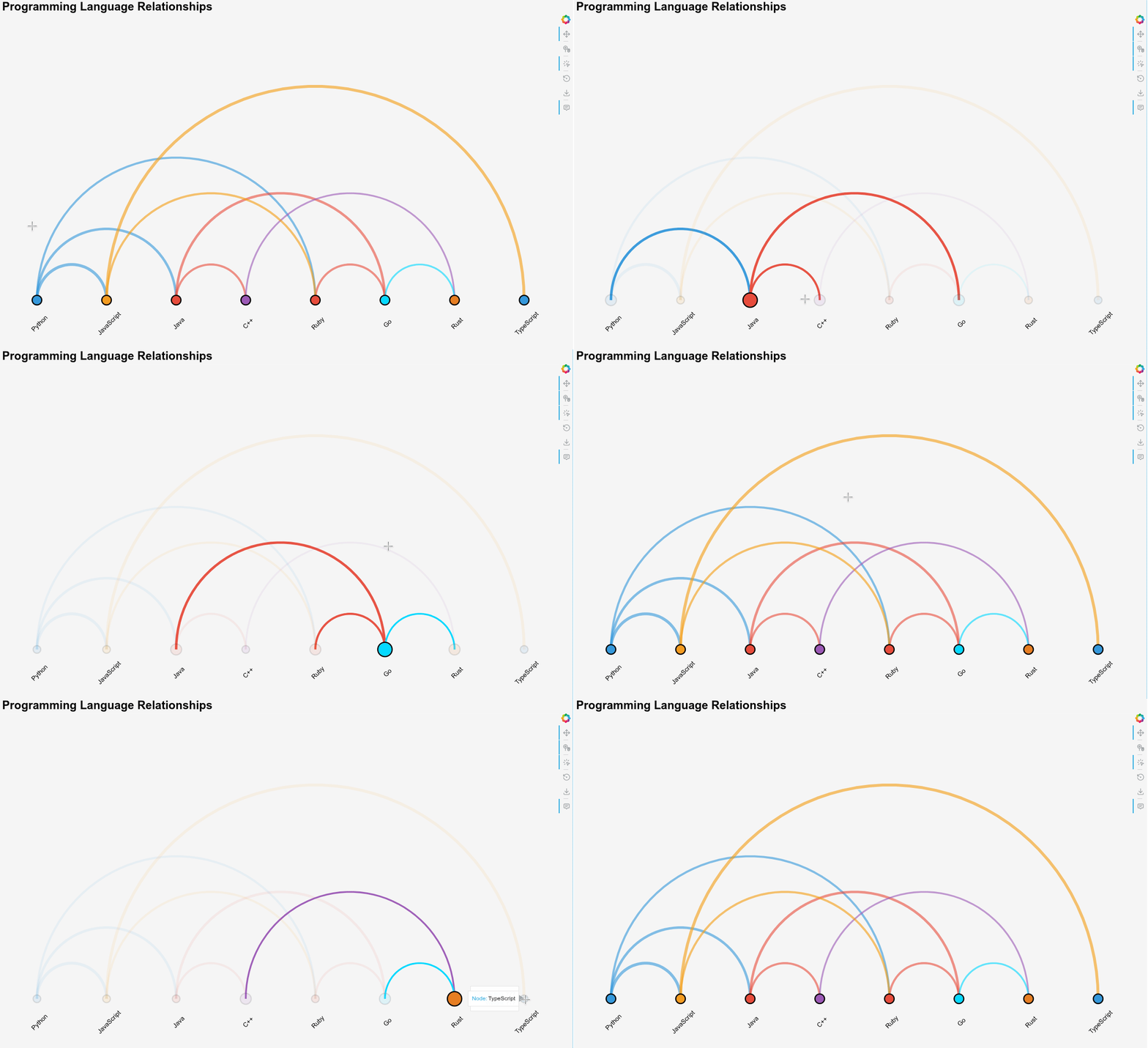
    # JavaScript callback for click interaction
    callback = CustomJS(
        args=dict(
            node_source=node_source,
            edge_sources=edge_sources,
            edge_pairs=edge_node_pairs,
            edge_widths=edge_widths,
            base_node_size=node_size
        ),
        code="""
            const indices = node_source.selected.indices;

            if (indices.length > 0) {
                const clicked = indices[0];

                // Update edges
                for (let i = 0; i < edge_sources.length; i++) {
                    const edge = edge_sources[i];
                    const [src, tgt] = edge_pairs[i];

                    // Get current renderer
                    const renderers = Bokeh.documents[0].roots()[0].renderers;
                    const edge_renderer = renderers.find(r => r.name === 'edge_' + i);

                    if (edge_renderer) {
                        if (src === clicked || tgt === clicked) {
                            // Highlight connected edges - keep original width
                            edge_renderer.glyph.line_alpha = 0.95;
                        } else {
                            // Dim unconnected edges
                            edge_renderer.glyph.line_alpha = 0.08;
                        }
                    }
                }

                // Update nodes
                const node_alphas = node_source.data['alpha'];
                const node_sizes = node_source.data['size'];

                for (let i = 0; i < node_alphas.length; i++) {
                    if (i === clicked) {
                        node_alphas[i] = 1.0;
                        node_sizes[i] = base_node_size * 1.5;
                    } else {
                        // Check if node is connected to clicked node
                        let connected = false;
                        for (let j = 0; j < edge_pairs.length; j++) {
                            const [src, tgt] = edge_pairs[j];
                            if ((src === clicked && tgt === i) || (tgt === clicked && src === i)) {
                                connected = true;
                                break;
                            }
                        }
                        node_alphas[i] = connected ? 1.0 : 0.2;
                        node_sizes[i] = connected ? base_node_size * 1.15 : base_node_size * 0.8;
                    }
                }

                node_source.change.emit();

            } else {
                // Reset all to original state
                for (let i = 0; i < edge_sources.length; i++) {
                    const renderers = Bokeh.documents[0].roots()[0].renderers;
                    const edge_renderer = renderers.find(r => r.name === 'edge_' + i);
                    if (edge_renderer) {
                        edge_renderer.glyph.line_alpha = 0.6;
                        edge_renderer.glyph.line_width = edge_widths[i];
                    }
                }

                const node_alphas = node_source.data['alpha'];
                const node_sizes = node_source.data['size'];

                for (let i = 0; i < node_alphas.length; i++) {
                    node_alphas[i] = 1.0;
                    node_sizes[i] = base_node_size;
                }

                node_source.change.emit();
            }
        """
    )

    # Add tap tool
    tap = TapTool(renderers=[nodes_renderer], callback=callback)
    p.add_tools(tap)

    # Add a deselection callback to reset when clicking background
    deselect_callback = CustomJS(
        args=dict(
            node_source=node_source,
            edge_sources=edge_sources,
            edge_widths=edge_widths,
            base_node_size=node_size
        ),
        code="""
            const indices = cb_obj.indices;

            if (indices.length === 0) {
                // Reset all edges when deselected
                for (let i = 0; i < edge_sources.length; i++) {
                    const renderers = Bokeh.documents[0].roots()[0].renderers;
                    const edge_renderer = renderers.find(r => r.name === 'edge_' + i);
                    if (edge_renderer) {
                        edge_renderer.glyph.line_alpha = 0.6;
                        edge_renderer.glyph.line_width = edge_widths[i];
                    }
                }

                // Reset all nodes to original size and alpha
                const node_alphas = node_source.data['alpha'];
                const node_sizes = node_source.data['size'];

                for (let i = 0; i < node_alphas.length; i++) {
                    node_alphas[i] = 1.0;
                    node_sizes[i] = base_node_size;
                }

                node_source.change.emit();
            }
        """
    )

    node_source.selected.js_on_change('indices', deselect_callback)

    # Add labels
    if show_labels:
        for i, (pos, label) in enumerate(zip(node_positions, nodes)):
            label_obj = Label(
                x=pos, y=-0.08,
                text=label,
                text_color=text_color,
                text_font_size='10pt',
                text_align='center',
                text_baseline='top',
                angle=np.pi/4
            )
            p.add_layout(label_obj)


    return p


def create_sample_network(network_type='simple'):
    """Create sample network data."""

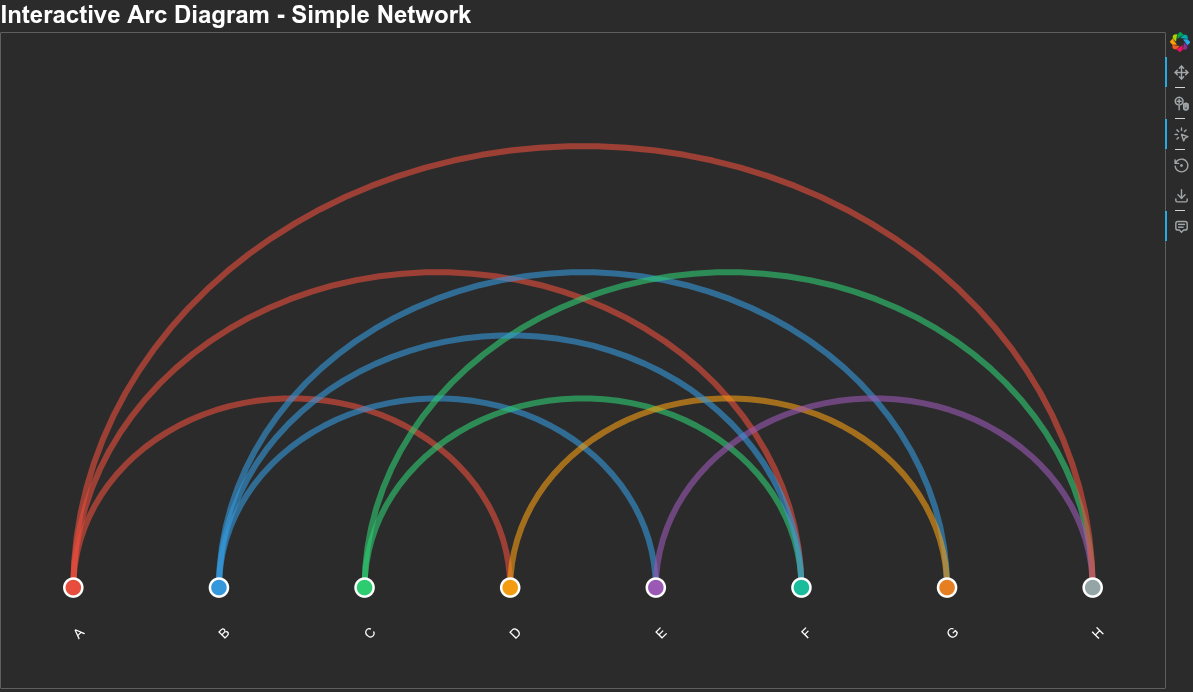
    if network_type == 'simple':
        nodes = ['A', 'B', 'C', 'D', 'E', 'F', 'G', 'H']
        edges = [(0, 3), (0, 5), (1, 4), (1, 6), (2, 5), (2, 7),
                 (3, 6), (4, 7), (0, 7), (1, 5)]
        colors = ['#e74c3c', '#3498db', '#2ecc71', '#f39c12',
                  '#9b59b6', '#1abc9c', '#e67e22', '#95a5a6']
        weights = None

    elif network_type == 'social':
        nodes = ['Alice', 'Bob', 'Carol', 'Dave', 'Eve', 'Frank', 'Grace', 'Henry', 'Iris', 'Jack']
        edges = [(0, 1), (0, 2), (0, 5), (1, 3), (1, 4), (2, 3), (2, 6),
                 (3, 7), (4, 5), (4, 8), (5, 9), (6, 7), (7, 9), (8, 9), (1, 6)]
        colors = ['#3498db'] * len(nodes)
        weights = [3, 5, 2, 4, 3, 5, 2, 3, 4, 2, 3, 4, 5, 3, 2]

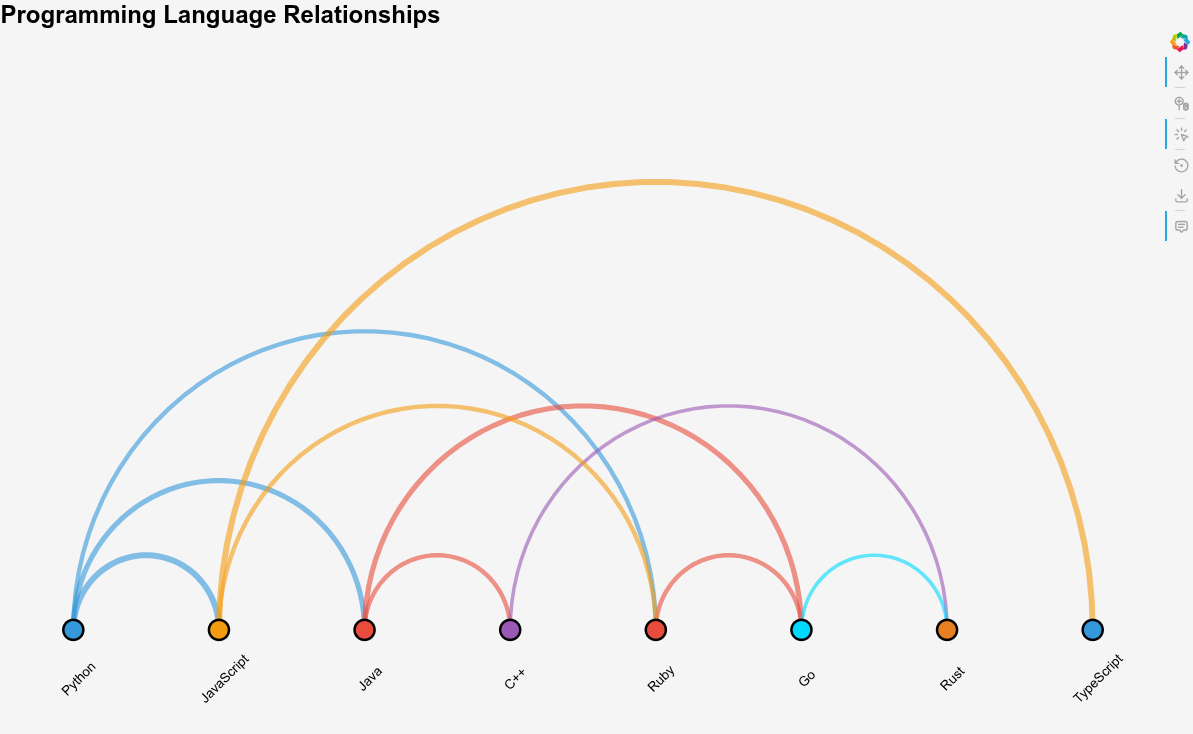
    elif network_type == 'tech':
        nodes = ['Python', 'JavaScript', 'Java', 'C++', 'Ruby', 'Go', 'Rust', 'TypeScript']
        edges = [(0, 1), (0, 2), (0, 4), (1, 7), (2, 3), (2, 5), (3, 6), (4, 5), (5, 6), (1, 4)]
        colors = ['#3498db', '#f39c12', '#e74c3c', '#9b59b6',
                  '#e74c3c', '#00d9ff', '#e67e22', '#3498db']
        weights = [5, 4, 3, 5, 3, 4, 2, 3, 2, 3]

    return nodes, edges, colors, weights


# ============================================================================
# EXAMPLES
# ============================================================================

if __name__ == "__main__":
    from bokeh.io import reset_output

    # Example 1: Simple Network (Dark Theme)
    print("Example 1: Simple Network - Click nodes to filter!")
    reset_output()

    nodes, edges, colors, weights = create_sample_network('simple')
    arc1 = plot_arc_diagram(
        nodes=nodes,
        edges=edges,
        node_colors=colors,
        title='Interactive Arc Diagram - Simple Network',
        width=1200,
        height=700,
        arc_height_scale=2,
        node_size=18
    )
    output_file("arc1_simple.html")
    show(arc1, browser=None)


    # Example 2: Social Network (Dark Theme)
    print("\nExample 2: Social Network")
    reset_output()

    nodes, edges, colors, weights = create_sample_network('social')
    arc2 = plot_arc_diagram(
        nodes=nodes,
        edges=edges,
        node_colors=colors,
        edge_weights=weights,
        title='Interactive Arc Diagram - Social Network',
        width=1400,
        height=800,
        node_size=16,
        arc_height_scale=3
    )
    output_file("arc2_social.html")
    show(arc2, browser=None)


    # Example 3: Tech Stack (Light Theme)
    print("\nExample 3: Programming Languages (Light Theme)")
    reset_output()

    nodes, edges, colors, weights = create_sample_network('tech')
    arc3 = plot_arc_diagram(
        nodes=nodes,
        edges=edges,
        node_colors=colors,
        edge_weights=weights,
        title='Programming Language Relationships',
        width=1200,
        height=750,
        node_size=20,
        arc_height_scale=2.2,
        dark_bg=False
    )
    output_file("arc3_tech_light.html")
    show(arc3, browser=None)