Warming Stripes now with Bokeh and random data!
from bokeh.plotting import figure, show, output_file
from bokeh.models import LinearColorMapper, ColorBar, BasicTicker, ColumnDataSource
from bokeh.layouts import column
from bokeh.models import Title
import pandas as pd
import numpy as np
from bokeh.palettes import RdBu11

def create_stripes_plot(data, year_col, value_col,
                        title="Warming Stripes", subtitle=None,
                        width=1200, height=400,
                        palette=None, reference_period=None,
                        output_path=None):
    """
    Create a 'warming stripes' visualization using Bokeh.

    Parameters:
    -----------
    data : pandas.DataFrame
        Data containing years and temperature/value data
    year_col : str
        Column name for years
    value_col : str
        Column name for values (e.g., temperature anomaly)
    title : str
        Main plot title
    subtitle : str
        Optional subtitle
    width : int
        Plot width in pixels
    height : int
        Plot height in pixels
    palette : list
        Optional color palette (defaults to blue-white-red)
    reference_period : tuple
        Optional (start_year, end_year) to calculate baseline average
    output_path : str
        Optional file path to save HTML output

    Returns:
    --------
    bokeh.plotting.figure
        The configured Bokeh figure
    """

    # Prepare data
    df = data.copy().sort_values(year_col).reset_index(drop=True)

    # Calculate anomaly relative to reference period if specified
    if reference_period:
        start_year, end_year = reference_period
        baseline = df[(df[year_col] >= start_year) &
                      (df[year_col] <= end_year)][value_col].mean()
        df['anomaly'] = df[value_col] - baseline
        plot_value = 'anomaly'
    else:
        plot_value = value_col

    # Calculate stripe boundaries
    df['left'] = df[year_col] - 0.5
    df['right'] = df[year_col] + 0.5
    df['bottom'] = 0
    df['top'] = 1

    # Default palette (blue to white to red)
    if palette is None:
        palette = list(reversed(RdBu11))  # Blue (cold) to Red (warm)

    # Create color mapper
    color_mapper = LinearColorMapper(
        palette=palette,
        low=df[plot_value].min(),
        high=df[plot_value].max()
    )

    # Create ColumnDataSource
    source = ColumnDataSource(df)

    # Create figure without axes
    p = figure(tools = "hover,save",tooltips=[(year_col, f"@{year_col}"), (value_col, f"@{value_col}")],
        width=width,
        height=height,
        x_range=(df[year_col].min() - 0.5, df[year_col].max() + 0.5),
        y_range=(0, 1)
    )

    # Plot vertical stripes (one per year)
    p.quad(
        left='left',
        right='right',
        bottom='bottom',
        top='top',
        color={'field': plot_value, 'transform': color_mapper},
        line_color=None,
        source=source,
        hover_line_color='lime',
        hover_line_width=2
    )

    # Add color bar
    color_bar = ColorBar(
        color_mapper=color_mapper,
        ticker=BasicTicker(desired_num_ticks=10),
        label_standoff=12,
        location=(0, 0),
        title="°C" if "temp" in value_col.lower() else "Value"
    )
    p.add_layout(color_bar, 'right')

    # Styling
    p.xaxis.axis_label = None
    p.yaxis.visible = False
    p.xgrid.visible = False
    p.ygrid.visible = False
    p.outline_line_color = None

    # Add year labels at key points
    key_years = []
    min_year = df[year_col].min()
    max_year = df[year_col].max()

    key_years = list(range(int(min_year), int(max_year), 20))


    p.xaxis.ticker = key_years
    p.xaxis.major_label_text_font_size = "12pt"

    # Add reference period markers if specified
    if reference_period:
        start_year, end_year = reference_period
        # Add text annotations
        p.text(x=[start_year], y=[1.05], text=[str(start_year)],
               text_align="center", text_font_size="10pt")
        p.text(x=[end_year], y=[1.05], text=[str(end_year)],
               text_align="center", text_font_size="10pt")

    # Create title layout
    title_obj = Title(text=title, text_font_size="16pt")
    p.add_layout(title_obj, 'above')

    if subtitle:
        subtitle_obj = Title(text=subtitle, text_font_size="10pt", text_font_style="italic")
        p.add_layout(subtitle_obj, 'above')

    # Save to file if specified
    if output_path:
        output_file(output_path)

    return p


# ============================================================================
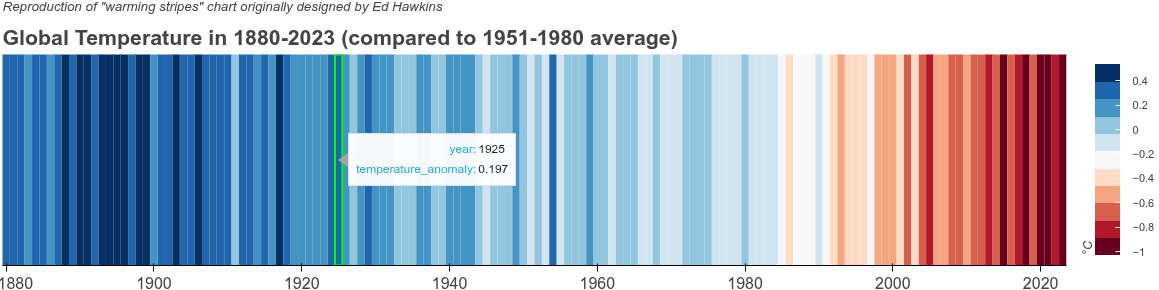
# EXAMPLE 1: Global Temperature Stripes (Like Ed Hawkins' warming stripes)
# ============================================================================

# Generate realistic temperature data from 1880-2023
years = list(range(1880, 2024))
np.random.seed(42)

# Create temperature anomaly with warming trend
temp_data = []
for i, year in enumerate(years):
    # Base trend: cooling until 1910, then warming acceleration
    if year < 1910:
        trend = -0.3 + (year - 1880) * 0.002
    elif year < 1980:
        trend = -0.2 + (year - 1910) * 0.005
    else:
        trend = 0.15 + (year - 1980) * 0.02

    # Add natural variability
    noise = np.random.normal(0, 0.1)
    temp_anomaly = trend + noise

    temp_data.append({
        'year': year,
        'temperature_anomaly': -temp_anomaly
    })

temp_df = pd.DataFrame(temp_data)

plot1 = create_stripes_plot(
    data=temp_df,
    year_col='year',
    value_col='temperature_anomaly',
    title='Global Temperature in 1880-2023 (compared to 1951-1980 average)',
    subtitle='Reproduction of "warming stripes" chart originally designed by Ed Hawkins',
    reference_period=(1951, 1980),
    height=300,
    output_path='example1_warming_stripes.html'
)

show(plot1)


# ============================================================================
# EXAMPLE 2: Arctic Sea Ice Extent Stripes
# ============================================================================

# Generate Arctic sea ice extent data (declining trend)
ice_years = list(range(1979, 2024))
ice_data = []

for i, year in enumerate(ice_years):
    # Declining trend with variability
    base_extent = 7.5 - (year - 1979) * 0.08  # Million km²
    noise = np.random.normal(0, 0.3)
    extent = base_extent + noise

    ice_data.append({
        'year': year,
        'ice_extent': extent
    })

ice_df = pd.DataFrame(ice_data)

plot2 = create_stripes_plot(
    data=ice_df,
    year_col='year',
    value_col='ice_extent',
    title='Arctic Sea Ice Extent 1979-2023',
    subtitle='Minimum extent (million km²) - showing declining trend',
    height=300,
    output_path='example2_arctic_ice.html'
)

show(plot2)


# ============================================================================
# EXAMPLE 3: Ocean Heat Content Stripes
# ============================================================================

# Generate ocean heat content data (increasing trend)
ocean_years = list(range(1960, 2024))
ocean_data = []

for i, year in enumerate(ocean_years):
    # Increasing trend with acceleration
    if year < 1990:
        trend = (year - 1960) * 2
    else:
        trend = 60 + (year - 1990) * 8

    noise = np.random.normal(0, 15)
    heat_content = trend + noise

    ocean_data.append({
        'year': year,
        'ocean_heat': heat_content
    })

ocean_df = pd.DataFrame(ocean_data)

# Custom palette (cool to hot)
ocean_palette = ['#08519c', '#3182bd', '#6baed6', '#9ecae1', '#c6dbef',
                 '#fee5d9', '#fcae91', '#fb6a4a', '#de2d26', '#a50f15']

plot3 = create_stripes_plot(
    data=ocean_df,
    year_col='year',
    value_col='ocean_heat',
    title='Ocean Heat Content 1960-2023',
    subtitle='Upper 2000m heat content anomaly (10²² Joules)',
    palette=ocean_palette,
    height=300,
    output_path='example3_ocean_heat.html'
)

show(plot3)